hamanteh.
Our communities

Central River · town

Bansang

An inland hospital town with a documented 1938 opening and a place in the groundnut and livestock-market networks.
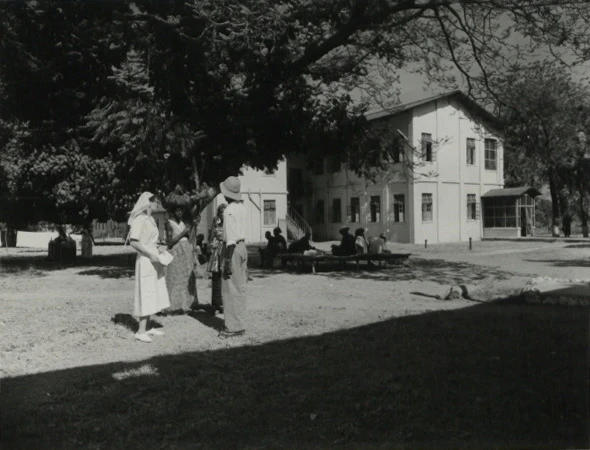
Staff and visitors outside Bansang Hospital
Archive photograph Archive image · June 1959 · Photographer not identified; held by The National Archives UK View source
2 research threads5 named sources Open for local knowledge

Gathering what this circle has shared so far.

Chapter 01

Present-day operations

A working ferry network along the middle and upper river

The Gambia Ferry Services Company, a subsidiary of the Gambia Ports Authority formed under the Companies Act 2013, operates eight crossing points along the river and its tributaries. Alongside the Banjul-Barra crossing at the river mouth and the former TransGambia crossing at Farafenni-Soma, its own list names Janjanbureh, linking Lamin Koto on the north bank to the island formerly called MacCarthy Island, together with crossings at Kaur, Barajally, Bansang, Basse and Fatoto.

The company describes Banjul-Barra as its busiest crossing, running close to continuously, and states that the TransGambia route was historically its second-busiest until the Senegambia Bridge opened in 2019, after which the company took on toll-collection management for the bridge itself. Its stated mission is to connect people and places across the river and its tributaries, a role that for Janjanbureh, Kaur, Bansang, Basse and Fatoto continues a much older pattern of river crossings touched on elsewhere in this archive's colonial-era travel sources.

Sourced media: A working ferry network along the middle and upper river

View this photograph at its source

The Janjanbureh-Lamin Koto ferry crossing

A 2009 photograph from the Janjanbureh-Lamin Koto ferry crossing.

Niels Broekzitter. CC BY 2.0 · Source: File: Gambia & Senegal 2009 (3686635617).jpg

A familiar name, a remembered voice. What would you add to the story of Bansang?

Add your memory

Chapter 02

1938-2020 reports

Bansang's hospital and regional market links

The British administration's 1938 annual report records a new hospital opening at Bansang and lists it alongside Bathurst and Bwiam as one of three hospitals then operating in the colony and protectorate. The report documents an institutional opening, not the lived experience of patients or the reach of care to every rural community.

A 1976 World Bank appraisal listed a planned groundnut depot at Bansang, while the agriculture ministry's later programme listed Bansang among Central River's weekly livestock markets. These differently dated records connect the town to crop and animal trade, but the depot plan is not evidence of completion and the market listing is not a local oral history.

Terranga. There is room for you here.

What does Bansang
mean to you?

A name you remember. A photograph in a drawer. A voice you want the next generation to hear. You do not need a complete history to add something meaningful.

Share a memorySign the guest book

From nearby or far away, in the language that feels like home. New contributions are reviewed with care before they appear.

A place at the table

The Bansang guest book

A greeting from afar. A familiar corner. Someone you remember.

Leave a few words

Everyone can read this book. Sign in to write. The care team reviews each note before it appears.

Please leave out private contact details and anything you do not have permission to share.

This connection can be published with your note. Leave it blank if you prefer.

Checking your sign-in...

No AI processing is requested for guest-book notes. For photos, recordings or a longer story, share a memory.

Words from the circle

Community memories and greetings, not independently verified historical findings.

Opening the guest book...

The story keeps growing.

Keep Bansang close.

Find your way back as more memories join the circle.

Checking your saved communities.

WhatsAppFacebook

The sources behind the story

Historical accounts are kept distinct from personal memories. Follow these sources to explore the evidence, different accounts and what remains uncertain.

Historical sources

  1. Annual Report on the Social and Economic Progress of the People of The Gambia, 1938

    British Colonial Office; digitised by University of Illinois · 1939 report of 1938 · PDF viewer p. 17, online lines 700-729, Bansang hospital and regional facilities

    Rights: Historic colonial official report; rights not independently determined; short original paraphrases only

    Colonial service descriptions are institutional evidence, not an account of patients, local healers, or all village access.

  2. Appraisal of Rural Development Project: The Gambia, Report 1089a-GM

    World Bank / International Development Association · 1976-06-02 · PDF viewer pp. 83-84, report section 7.03-7.04 and Table 22, online lines 2873-2904

    Rights: Publicly disclosed historical report bearing an older restricted-distribution notice; only brief facts paraphrased

    Proposed depot bins at Tendeba/Kwinella, Kuntaur and Bansang are plans, not verified completions. Kaur's receiving/factory role is described as then existing. Do not infer present facilities.

  3. Gambia Agriculture Transformation Programme 2020-2030, final report

    Ministry of Agriculture, Republic of The Gambia · 2020 · PDF viewer pp. 86-87, section 4.8.4 and Table 13, online lines 3600-3646; p. 149 planned market improvements

    Rights: Government policy report; original paraphrases only

    Describes 2018/2019 weekly livestock market inventory and proposed upgrades. Table supports named market locations, not each market's founding date or subsequent redevelopment.

  4. Home Page

    Gambia Ferry Services Company Ltd, a subsidiary of the Gambia Ports Authority · Company overview and crossing-points list naming Banjul-Barra, TransGambia (Farafenni-Soma), Janjanbureh (Lamin Koto-MacCarthy Island), Kaur, Barajally, Bansang, Basse and Fatoto

    Rights: Company web page; original paraphrases only

    A live operator page describing current routes and company history, not a chronology of when each individual crossing began or a guarantee of present-day schedules and fares.

  5. File: Gambia & Senegal 2009 (3686635617).jpg

    Wikimedia Commons · 2009-06-26 · File description page: license, author and capture-date metadata read via the Wikimedia Commons API

    Rights: CC BY 2.0; https://creativecommons.org/licenses/by/2.0

    A 2009 photograph from the Janjanbureh-Lamin Koto ferry crossing category, originally posted to Flickr and uploaded to Commons under this license.

Back to the story