
Banjul · city
Banjul
Also recorded as Bathurst
The island capital, known as Bathurst in the British colonial period; its 2024 LGA count is 26,461 in the preliminary census.
Gathering what this circle has shared so far.
Chapter 01
Materials from late 1940s onward; article 2011
A Banjul historian’s personal archive
Hassoum Ceesay’s tribute says A.E. Cham Joof kept letters, stamps, invitations and voters’ cards from the late 1940s for historical writing. It is not a public-domain archive or reuse permission.
A familiar name, a remembered voice. What would you add to the story of Banjul?
Add your memoryChapter 02
1883-1922, reported in 2020
A Bathurst newspaper gap
Ceesay says Bathurst had no newspaper after the Bathurst Observer ended in 1883 until E.F. Small founded The Gambia Outlook and Senegambia Reporter in 1922. Pamphlets at MacCarthy Square responded to that reported gap.
Chapter 03
1920s, reported in 2020
A cross-border route for Bathurst printing
The article reports that Small edited in Bathurst, printed in Rufisque and distributed across several places. Verify this Senegambian publishing route against surviving issues and business records.
Chapter 04
1886-1930s
A documented Williams household on Lovell Street
Liza Gijanto traces a Williams family home at 2 Lovell Street to an 1886 deed. A Wesleyan church stood close to the yard; family members served as organists, government printers and ship pilots. John Williams appeared among six pilots licensed under an 1862 ordinance to guide vessels between the river entrance and Bathurst port.
Property listings into the 1930s record rooms rented to labourers and migrants, including workers in the United Africa Company and Public Works Department. Excavated local cooking pots, imported tablewares and fish remains reveal domestic choices that cross the easy division between African and European material culture. The archaeologist interprets these as negotiations of status and economic necessity, not a simple inventory of wealth.
The study also names Julia Williams as a nurse. Its household case shows that women as well as men held skilled positions, while the mixed-class yard linked a prosperous family with working tenants. The record belongs to this documented household and period.
Chapter 05
1956-1970s
A jali's reputation carried by radio
The kora player Jali Nyama Suso began a radio career in 1956 and became known nationally for a weekly programme on Radio Gambia. By the mid-1960s he had gained wide recognition, reportedly including patronage from the Gambian president's first wife, an example of griot performance reaching well beyond the courtyards and ceremonies where it was traditionally heard.
Suso's own career points to a broader pattern. After losing a leg at sixteen, his performing life depended more on broadcast and recording than on travel to distant ceremonies, and by the early 1970s he was recording internationally, including a first solo album made while teaching at the University of Washington. Radio had become one route by which a jali's reputation could reach a national, and eventually international, audience without constant physical travel.
Chapter 06
Founded mid-19th century; fire reported September 2014
Albert Market: a colonial name and a 2014 fire
Wikipedia's Albert Market article states the market was built in the mid-nineteenth century on what is now Liberation Avenue in Banjul and was named for Albert, Prince Consort, husband of Queen Victoria, during British colonial administration. The article itself is flagged as thinly sourced, citing only two tourism-information pages, so this archive treats the founding date as an approximate, attributed claim pending a scholarly or archival source.
The Point newspaper reported that a fire gutted part of Albert Market, with a trader describing losses including recently imported clothing and shoes. Gambia's National Disaster Management Agency, the Red Cross and the Fire and Rescue Service all responded, and the market committee chairman urged traders to insure their stalls against future loss. This is a single dated news event, not a record of the market's full fire history.
Sourced media: Albert Market: a colonial name and a 2014 fire
Banjul Albert market
Albert Market in Banjul, photographed in 2003.
sachara. CC BY-SA 3.0 · Source: File: 1014036-Banjul Albert market-The Gambia.jpg
Chapter 07
1960 onward
Ballot tokens and drums
The Gambian government's electoral history says ballot tokens and metal drums were introduced just before the first general election of 31 May 1960. The method is a practical part of the country's political culture, not a substitute for the complex history of suffrage and representation.
The official account links that election with a new constitution and universal suffrage at a voting age of 21. An archive entry can pair an object or remembered polling experience with this dated institutional context, but should not invent a witness account.
Chapter 08
1973-2024
Banjul's shrinking census count
The preliminary 2024 census counts 26,461 people in Banjul LGA, compared with 44,188 in 1983 and 31,054 in 2013. These are administrative-area counts, not a measure of Half Die or any one neighbourhood.
In the same table, Brikama LGA rises to 1,151,128 in 2024. The contrast describes an uneven national geography; it does not by itself identify why any particular family moved or establish that every former Banjul resident went to Brikama.
Chapter 09
19th century
Bathurst's planned quarters and port
In the early town, major streets led toward port warehouses on Wellington Street. The planned separation of government, mercantile and residential spaces appears in archaeological and archival study, yet each quarter developed through the people who worked and settled there.
Names including Soldier Town and Portuguese Town preserve parts of that social geography. Their histories should not be flattened into a single ethnicity: Liberated Africans, Luso-African traders, colonial troops and other residents inhabited overlapping worlds.
Chapter 10
Present-day, with roots the source attributes to the historic Jolof Empire
Benachin, one pot under pressure
Benachin, meaning one pot in Wolof, cooks rice, vegetables and a protein, most often sardinella, together in a single pot. A 2025 account of the dish traces the culinary lineage commonly associated with it back to the historic Jolof Empire, and describes it, in one chef's words, as a dish that 'can't be left out of any cultural occasion' across Gambia and Senegal alike.
The same account documents a present-day threat to the dish's usual ingredients: industrial overfishing of sardinella across West Africa, rising sea temperatures, and sardinella prices that the reporting describes rising roughly fivefold over seven years. Some households have substituted imported frozen chicken as the traditional fish becomes costlier, a change to a national dish driven by pressure on the fishery rather than by taste.
Chapter 11
1816-1824
Building Bathurst against water
The later colonial chronology dates Bathurst's foundation on Banjol Island to 1816. Writing within a decade, Sarah Bowdich Lee described dikes, cleared vegetation, sandy ground and high tides that pressed against the new town's shore. Her health explanation used contemporary miasma theory, but the observed water and drainage problems remain valuable as an early urban account.
Bowdich described unusually wide streets and plots granted with requirements to build and keep street space open. She also noted a proposed market place and sea wall, while another passage describes stone brought from Dog Island and lime made from oyster shells. These are choices and proposals in an 1820s colonial town, not proof that all planned works were completed.
Chapter 12
2024 census and 2016-2030 policy
Census categories do not tell us which language someone speaks
The preliminary 2024 census displays national ethnic categories such as Mandinka, Fula, Wollof, Sarahule and Jola. The education policy separately names languages for teaching. The categories overlap in names but are not the same measurement.
Neither source reports the languages spoken by any named individual in the archive. Transcription, translation and search labels therefore need to be based on the contribution itself and consented contextual information, not a surname or a census percentage.
Chapter 13
2021-2023 project proposal
Community inventory as living-heritage work
UNESCO's capacity-building project proposed training Gambian stakeholders on safeguarding intangible cultural heritage and undertaking a pilot community-based inventory. Its scope was policy and method, not a one-time list of traditions fixed forever.
The published page describes a proposed project. It cannot by itself verify which sessions took place or what particular community agreed to share, so any later claim about a named practice needs its own bearer-led evidence and permissions.
Chapter 14
1926 episode reported in 2020
Editorial independence in a reported 1926 episode
Ceesay recounts a 1926 financing proposal that would put a backer in management, and says Small refused for editorial independence. Read the cited 1958 item before treating this as settled biography.
Chapter 15
2016-2030 policy
Five languages named in an education policy
The Gambia's education policy proposes strengthening teaching of five commonly used languages as subjects: Wollof, Pulaar, Mandinka, Jola and Sarahule. It also proposes exploring inclusion of Serere and Manjago.
This is a policy aim, not evidence that every school teaches all five or that a speaker's community can be inferred from their address. Oral archive cataloguing should record the language actually spoken in a contribution and preserve a speaker's own naming preference.
Chapter 16
1948-1953
Florence Peters and a father's education petitions
Historian Catherine Cymone Fourshey follows Lenrie Peters's efforts to secure his daughter Florence's education, sponsorship and passage between Britain and Bathurst in the late 1940s and early 1950s. The published abstract frames the episode as a father's family ambition set against a colonial administration's narrow expectations for women's education.
Florence returned to Bathurst in early 1953 after six years of study in England, with her father paying for her journey. The scholar argues that a colony claiming to pursue development invested little in education while relying on the skill of women such as Florence. This one family's records offer a window on that structural contradiction.
Chapter 17
1816-20th century
Fort Bullen and the abolition-era river mouth
The Six-Gun Battery on the south bank dates to 1816 and Fort Bullen on the north bank to 1826. UNESCO describes their purpose as intercepting illegal slave shipping after Britain's 1807 abolition of its slave trade.
That declared purpose is not a complete moral account of British rule. The same fortifications also helped consolidate colonial control, while Fort Bullen was reused as a strategic post during the Second World War.
Chapter 18
Pre-colonial daara tradition; unified curriculum from 1996; 2003-04 enrolment recorded
From daara to a national Islamic-school curriculum
Traditional daara and maglis schools taught the Quran and Islamic practice long before, and largely outside, the colonial and early post-colonial education system, and are described as having played a critical role in basic-education access despite that marginal status.
In 1996 the government created a General Secretariat for Islamic and Arabic Education inside the Ministry of Education and introduced a unified curriculum across public and Islamic schools, adding Arabic, English, local languages, mathematics, science, history, geography and vocational subjects alongside religious instruction. By the 2003-04 school year, roughly 162 madrassas were enrolling 55,685 learners nationally, 28,234 boys and 21,859 girls, about a fifth of all school-age children, concentrated in low-income rural and urban communities.
Chapter 19
1816 treaty; groundnut-era 19th-20th century; tourism from 1965
From the 1816 Kombo treaty to the 1970 Tourism Development Area
Wikipedia's account of Alexander Grant states that on 23 April 1816, Grant, acting for Britain, agreed a lease of St Mary's Island with Tomani Bojang, described as King of Kombo, for an annual payment of 103 iron bars then worth about twenty-five pounds, founding the settlement later renamed Bathurst. Britain's later acquisition of the Ceded Mile on the north bank is described as widening the same trading foothold at the river mouth, within and alongside Kombo territory.
Wikipedia's article on tourism in the Gambia states that this later industry grew up alongside continuing groundnut, or peanut, exports, the colonial-era economic mainstay that had dominated Kombo and the wider country since the nineteenth century. This archive does not yet have a directly read source for the nineteenth-century Kombo groundnut trade itself and flags that as an open research task rather than asserting a continuous economic narrative.
The same article states that organised tourism began in 1965 when the Swedish operator Vingresor, working with Bertil Harding, brought roughly 300 Swedish visitors to Bathurst, and that visitor numbers grew to about 2,600 by 1970 to 1971 and over 8,000 by 1971 to 1972, with hotels increasing from two in 1965 to thirteen by the early 1970s. It adds that in 1970 the government designated an eight-hundred-metre-wide coastal Tourism Development Area running from Kololi to Kartong, which set the geography for later beach-resort growth at Kotu, Fajara, Bakau, Kololi and the Senegambia strip near Serekunda.
Chapter 20
1848-1986
Groundnuts from migrant field to Banjul wharf
Commercial groundnut cultivation along the Gambia River drew local and long-distance migrant farmers from the mid-nineteenth century. A historian's study of 1848 to 1895 describes migrants who at first paid a customary fee to local rulers for the right to farm, then moved into labour-sharing arrangements with host farmers as domestic slavery declined. This became known as the Strange Farmer system, and it supplied the extra seasonal labour that low-population farming areas needed to grow the crop for market.
Brikama's own documented history of migration, host-guest farming relationships and ward-level organisation, already part of this archive through a separate twentieth-century study of Senegalese migrants, sits inside that same wider Strange Farmer economy. Upper River towns such as Basse, long recorded as a transit centre toward the interior, occupied a comparable position within river-borne groundnut commerce. This entry does not claim a specific documented Strange Farmer settlement at either town, only that both sat within the same regional system Swindell describes.
At the river's mouth, the crop reached Banjul's processing and export point. Oyster Creek, beside the modern Denton Bridge, completed in 1986 and named for a former governor, Sir George Chardin Denton, still holds peanut-processing warehouses and a factory, a working trace of the export chain's Banjul end.
Chapter 21
1993 onward, reported in 2011
History Corner as a public-history practice
Ceesay writes that Cham Joof began the Daily Observer’s History Corner in 1993 and invited him to take it over in 1996. The account shows how newspaper columns became a route for sharing local history beyond formal archives.
Chapter 22
1905-1965
Household claims in Bathurst's Muslim court
Bala Saho's study draws on qadi court records and two hundred interviews in Wolof and Mandinka to examine urban Muslim family life. Following the court's 1905 establishment, cases brought questions of marriage, bridewealth, maintenance, divorce, child custody and property into a recorded forum.
The book describes women using that forum to pursue domestic and property claims, with some judges sympathetic to their arguments. These disputes show households negotiating rights within Islamic, local and colonial legal settings, rather than passively receiving a single rule from outside.
Chapter 23
1965, with the 1970 republic vote recalled alongside it
Independence night at MacCarthy Square
Just before midnight on 17 February 1965, crowds gathered at MacCarthy Square in Bathurst as the Garrison Bell struck from the Ministry of Finance. A retrospective commentary recalls the Union Jack lowered for the last time and the newly designed Gambian flag, in red, blue and green bands, raised by Harry Kates as independence took effect at midnight.
The formal handover the next morning brought the Duke and Duchess of Kent to deliver the instruments of independence to Prime Minister Sir Dawda Kairaba Jawara. The same account recalls gymnastics displays led by P.E. instructor James B. Abraham, fireworks and drumming, and the royal couple's departure through cheering crowds, the kind of local, sensory detail that a bare constitutional chronology does not carry on its own.
The move to republican status was not decided in the same moment. A first referendum in November 1965 fell short of the required majority; a second vote succeeded five years later, ending the country's constitutional link to the British monarchy in April 1970. Both dates belong to Banjul's own streets and square as much as to a national chronology.
Chapter 24
2013 census analysis
Moving within The Gambia and carrying a place with you
GBoS compared place of birth with place of enumeration in 2013 and found Kanifing and Brikama LGAs received most recorded internal migrants. It also notes Banjul's island housing constraint as one part of the wider pattern.
Kea's fieldwork in Brikama, at a different scale, follows the ways women migrants gained access to land through hosts and participated in farming and reciprocal work. Her account shows how belonging could be negotiated socially even when a census records only a birthplace and current area.
Chapter 25
Second World War to 1970s materials; article 2011
Photographs as a record of Banjul public life
The tribute reports that Cham Joof’s photographs included scenes from nationalist politics, a 1968 funeral and 1970s Radio Gambia. It supports the existence of a potentially important visual record, while leaving its current location, captions and reuse rights unresolved.
Chapter 26
19th century
Portuguese Town's Atlantic connections
Gijanto describes Portuguese Town as a major settlement area for Liberated Africans arriving through Sierra Leone, including people with wider Atlantic journeys. Luso-African merchants from Gorée also figured in this commercial quarter.
The quarter developed beside Wellington Street's river-facing warehouses and became one of early Bathurst's wealthier areas. Its inhabitants were part of a city with Muslim, Wesleyan and other Christian communities, where work in commerce, military service and government intersected with Atlantic migration.
Chapter 27
Present archival practice
Recording history is not the same as owning it
Hamburg's project description names difficult storage conditions, lack of financial support, legal questions and ownership disputes as threats to the national collection. Its digital work addresses preservation and access, not every social question around a recording.
The TRRC separately calls for testimony to be preserved and retold sensitively, with victims' interests in view. Across very different archive types, the responsible lesson is to connect each account with its context and permissions rather than treating digitisation as blanket publication consent.
Chapter 28
1820s-20th century
Soldier Town beyond the barracks
The quarter contained British barracks and later Liberated African military units, documented from 1827. High mortality among British-born soldiers helped change it into a predominantly African neighbourhood.
A study of a Lovell Street property and surrounding deeds shows household ownership, worship, skilled employment and tenants in the same neighbourhood. This is a useful reminder that a military name does not describe every life lived there.
Chapter 29
1996-2007 designation record; living landscape
Tanbi, a working estuary
Ramsar designates the Tanbi Wetlands Complex across Banjul, Kanifing and Brikama administrative areas. Its summary describes a low estuary shaped by river and marine sediments with much of its area in mangrove habitat.
The site record names subsistence fishing, agriculture, oyster and mangrove harvesting alongside shoreline stabilization and shrimp breeding. These are linked ecological and human uses, not a claim that every nearby settlement depends on the wetland in the same way.
Chapter 30
1994-1996
The 1994 break in electoral rule
The government's electoral chronology identifies the July 1994 military coup that removed the elected Jawara government and installed the Armed Forces Provisional Ruling Council under Yahya Jammeh. This is a dated institutional break, not a neutral continuation of elections.
It also describes a transition plan and establishment of a provisional electoral commission in December 1995. A fuller account of abuses and their aftermath belongs alongside the Truth, Reconciliation and Reparations Commission's own evidence, which this batch has not yet evaluated at volume level.
Chapter 31
1870s-1941
The Forsters and a century of restricted representation
Hughes and Perfect trace Samuel John Forster's rise from Bathurst clerk to rice merchant, with family commercial ties inland. He opposed a proposed British cession of The Gambia to France in the 1870s, and in 1886 was appointed to the Legislative Council. The position was an appointment within a colonial government, not an elected mandate for the whole country.
After his death in 1906, his son Samuel John Forster entered the council in 1907. The younger Forster, a barrister educated in Britain, served repeated terms until 1940. Their family and political network included nephew W. Davidson Carrol, whose 1941 death ended the expected succession. This was an era when the Protectorate population was largely excluded from Bathurst's narrow council politics.
The historians describe rivalries among elite factions and the subsequent opening for Edward Francis Small. The story is therefore both a family history of public figures and a history of who could speak in colonial institutions, who could not, and how that changed.
Chapter 32
20th century
The Lady Wright and the river's later ferries
The Gambia Ports Authority's river fleet once included the steamer Lady Wright, later replaced by a new vessel, the Lady Chilel. A tribute to a former GPA managing director credits this replacement, alongside the purchase of the ocean-going vessel Bintang Bolong, as one of the Authority's milestone projects.
Ferry capacity grew through separate donor-financed projects: a first ferries project funded by the Netherlands government, and a second, in 1986, financed by the German government through KfW. These projects, rather than any single vessel, expanded how the river's crossings, not only its main channel, were served.
Sourced media: The Lady Wright and the river's later ferries
Banjul ferry
A ferry at Banjul, photographed in 2010.
dorothy.voorhees. CC BY-SA 2.0 · Source: File: Banjul Ferry (5197915925).jpg
Chapter 33
20th century collection; current digital access
The national oral archive as a research partner
The University of Hamburg's NCAC digital-archive partnership describes about 5,000 audio recordings of spoken art and oral traditions and about 1,200 written documents spanning Senegambia and neighbouring areas. The numbers describe a collection, not material that this archive has listened to or cleared for reuse.
The partner points readers to a research data repository and stresses that digital access can widen educational use while original materials remain locally held. Individual record descriptions, language, provenance, rights and consent still require item-by-item checking.
Chapter 34
15th-20th centuries
The river as route and historical record
The Kunta Kinteh ensemble spans an island, fortifications and buildings near the river mouth. UNESCO interprets these places together because trade, enslavement, colonial control and later abolition unfolded along the same waterway rather than at a single fort.
The historic quarter of Janjanbureh, much farther inland, was put forward by The Gambia as a tentative extension of that coastal World Heritage story. Its streets, wharf and commercial buildings make the inland connection tangible, but tentative-list status is not inscription.
Chapter 35
1960-1970
Two national dates, two constitutional transitions
The government electoral history records universal suffrage in 1960, internal self-government in 1963 and independence on 18 February 1965. The independent state began as a constitutional monarchy within the Commonwealth.
A later referendum led to republican status on 24 April 1970. Keeping the two dates distinct avoids projecting the republic back onto the independence ceremony.
Chapter 36
2013 report
What the census cannot tell us about diaspora
The 2013 migration analysis says its international data principally describe people moving into The Gambia. It did not directly collect the number or characteristics of Gambians who emigrated abroad.
That gap matters for a living archive. A figure for internal migration, a person's surname, or a visitor's association with a memorial site cannot fill in an overseas family route; documents and voluntarily shared family accounts have to be evaluated on their own terms.
Chapter 37
2024-2025 reports
Why local-government counts need careful labels
GBoS reports 147,412 residents for Janjanbureh LGA in its preliminary 2024 census. That number covers the local government area and is not the population of the historic island town.
Its 2024 economic census counts operational entities by LGA, not by the town streets a visitor might walk. The distinction matters when placing statistical context beside an individual place story.
A picture can open a conversation.
Banjul, in photographs
These images come from named source records. They show a moment or a place, not the whole community story. If you know more, there is room for your memory too.
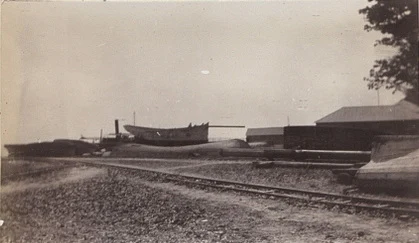
Archive photograph · December 1910
Boats along the Bathurst foreshore
not named. The National Archives (United Kingdom), Colonial Office photographic collection
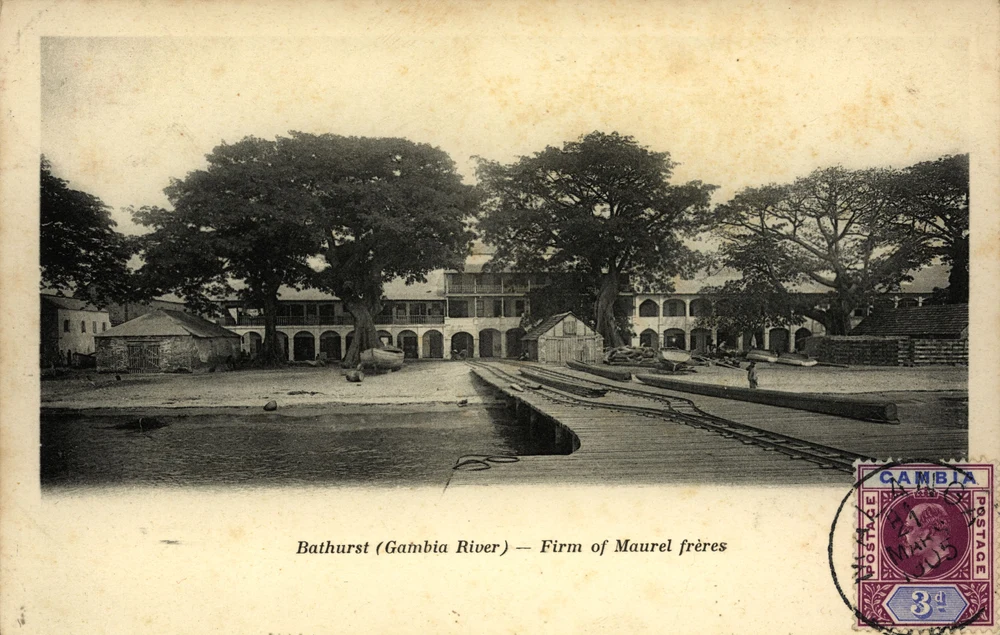
Archive photograph · circa 1910
The Maurel Freres trading house
unknown. Wikimedia Commons, postcard scan sourced from Université Paris 1 collection page
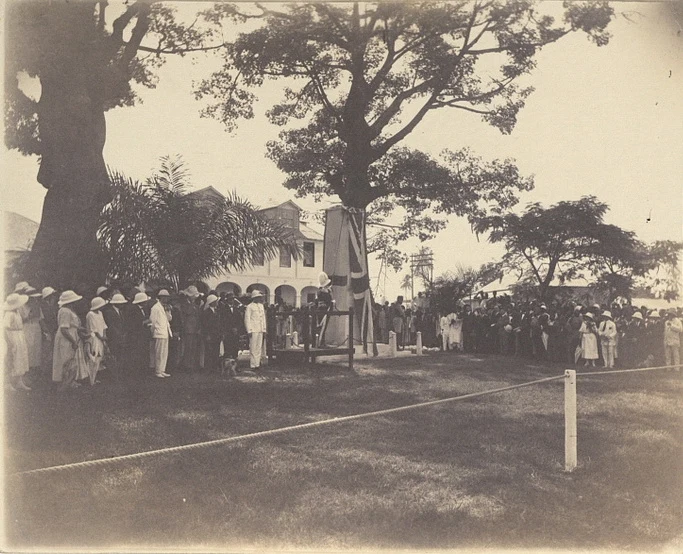
Archive photograph · 11 November 1922
The Gambia Cenotaph unveiling, 1922
not named. The National Archives (United Kingdom), Colonial Office photographic collection
Archival captions reflect the source’s wording; our display titles may be adjusted for clarity or caution. A later photograph does not show an earlier century. Image credits and reuse terms stay with each record in the photographic shelf.
Terranga. There is room for you here.
What does Banjul
mean to you?
A name you remember. A photograph in a drawer. A voice you want the next generation to hear. You do not need a complete history to add something meaningful.
From nearby or far away, in the language that feels like home. New contributions are reviewed with care before they appear.
A place at the table
The Banjul guest book
A greeting from afar. A familiar corner. Someone you remember.
Words from the circle
Community memories and greetings, not independently verified historical findings.
Opening the guest book...